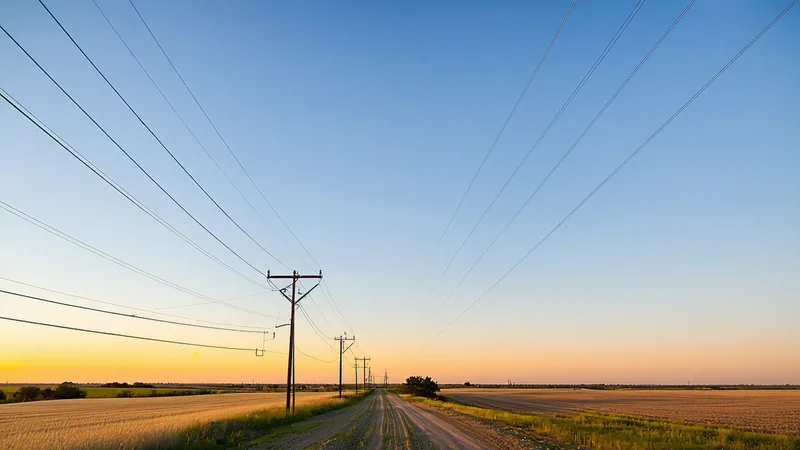
The connectivity challenge for distributed T&D asset monitoring is qualitatively different from anything you encounter in a substation or plant-floor environment. A substation has power, a structured network, physical security, and a maintenance team that visits regularly. A pole-top transformer 12 miles out on a rural feeder has none of those things — it has 120V secondary power, intermittent cellular signal depending on which carrier you chose and whether that tower is operational, and a crew visit every few years.
Getting telemetry reliably off those assets and into an analytics platform requires a different design mentality than substation SCADA integration. This post covers the connectivity options that work in practice, the conditions under which each one fails, and how the analytics layer needs to handle the inevitable gaps.
Cellular: The Default Uplink and Its Limitations
LTE and LTE-M (Cat-M1) are the default uplink options for most distributed field asset monitoring gateways, and for good reason: coverage in developed areas is adequate, the hardware cost is predictable, and no utility infrastructure investment is required. For the majority of transformers and reclosers in suburban and semi-rural distribution territory, cellular with a primary carrier and a secondary carrier failover covers 85–92% of assets adequately.
The problem is the tail — the 8–15% of assets in genuinely low-coverage areas where cellular performance is inadequate for reliable telemetry. These tend to cluster in specific geographic zones: river bottoms and terrain depressions where signal propagation is attenuated, areas between tower coverage zones in rural counties, and some industrial areas with high RF interference. For rural electric cooperatives serving sparsely populated territories, the low-coverage fraction can be considerably higher than for urban investor-owned utilities.
LTE-M (Cat-M1) has better penetration in low-signal environments than standard LTE because it uses narrower bandwidth and higher sensitivity receivers. For pole-top assets where the gateway antenna is mounted near transformer hardware that absorbs and reflects RF, LTE-M is often the better choice even in areas where LTE coverage exists. The tradeoff is lower throughput — LTE-M supports several hundred kilobits per second, which is more than sufficient for telemetry payloads (which are kilobytes per sample, not megabytes) but inadequate for any application requiring continuous video or high-rate waveform streaming.
RF Mesh for Higher-Density Feeders
For feeders where assets are closely spaced — urban distribution circuits with a transformer every few hundred feet, or industrial feeders with high asset density — 900 MHz RF mesh networking provides an alternative to individual cellular gateways. 900 MHz offers better range per hop than 2.4 GHz or 5 GHz mesh in outdoor environments with foliage and terrain, and many utilities already maintain 900 MHz licensed spectrum for AMI meter communication infrastructure.
The mesh architecture allows a group of monitoring nodes to share a single cellular uplink at the mesh gateway, reducing per-node cellular data costs for high-density deployments. The tradeoff is installation complexity: each hop in the mesh introduces latency and reliability dependencies, and a mesh network requires design engineering to ensure adequate path redundancy. A mesh node that loses its upstream neighbor needs an alternative path to the gateway, or data accumulates in the local buffer until connectivity is restored.
For rural feeders where assets are widely spaced (a mile or more between transformers on a rural lateral), RF mesh is generally not viable — the hop distances exceed the practical range of 900 MHz at distribution pole heights. Cellular is the only practical option for those assets, and the monitoring system needs to be designed to tolerate the gaps.
Store-and-Forward: The Critical Design Requirement
Any distributed asset monitoring gateway that operates in an area with imperfect connectivity must have on-device data buffering with store-and-forward capability. This is not an optional feature — it is a fundamental architectural requirement for monitoring deployments that include rural or low-connectivity assets.
The practical design question is buffer sizing. How long of a data outage can the local buffer absorb before data is lost? For typical telemetry sample rates (one reading per 5–15 minutes for temperature and load; higher rates for event-triggered vibration samples), a 72-hour buffer requires modest storage — on the order of 10–50 MB for most telemetry configurations. This is trivially achievable with embedded flash storage on any modern gateway hardware.
The more interesting question is what happens in the analytics layer when data arrives late. If a connectivity gap means a 36-hour block of telemetry arrives as a batch upload, the anomaly detection model needs to process it correctly: applying the correct timestamp to each sample, updating the asset's condition state appropriately, and not triggering false anomaly flags from the data arrival pattern itself. Fieldiq's ingest pipeline processes out-of-order telemetry batches by timestamp and updates the asset health index retroactively, so that the condition history is accurate rather than reflecting when data arrived.
Power Considerations at Remote Locations
Field asset monitoring gateways require power. For oil-immersed distribution transformers, the secondary 120V service is the most convenient power source — the transformer itself provides a reliable, continuously energized power tap for the monitoring gateway. For pad-mount transformers in commercial areas, this is straightforward. For single-phase pole-top transformers, a small transformer-mounted current transformer (CT) or secondary tap provides adequate power for a low-power gateway at very low cost.
Line reclosers and step voltage regulators present a different power situation. Modern electronic recloser controls have an internal power supply, and many support auxiliary power output to external devices. However, not all recloser controls provide sufficient auxiliary power for a full telemetry gateway, and older recloser controls may not provide auxiliary power at all. For these assets, the options are an independent solar power supply (viable in most of the US Southwest and Gulf Coast), a small capacitor-backed CT energy harvesting module on the line conductor, or a battery-backed gateway with extended-life lithium cells (practical for low-sample-rate monitoring with multi-year battery life, but not for high-frequency vibration sampling).
What Sparse Data Looks Like in Practice
It is worth being direct about what "handles sparse data windows" actually means in operational terms, because the marketing language around this concept often obscures the reality.
If a monitoring node goes dark for 48 hours, there are two possible reasons: the connectivity is down, or the asset has lost power (which itself may indicate a fault condition on the secondary). Distinguishing between these two cases from the monitoring platform requires a heartbeat signal — a periodic connectivity check that is separate from the telemetry data itself. When the heartbeat disappears, the platform should surface a connectivity alert, not an asset health alert, unless additional context (upstream SCADA switching events, outage management data) indicates a primary fault.
We are not suggesting that sparse data is acceptable as a steady-state condition. If a monitoring node consistently shows 30% data availability due to cellular coverage issues, that node's anomaly detection performance is compromised and the asset should either be moved to a more reliable connectivity architecture or explicitly flagged in the fleet risk dashboard as having reduced monitoring confidence. The store-and-forward capability handles transient outages well. It does not fix chronic connectivity problems, and claiming otherwise would misrepresent what the technology can do.
Connectivity Planning in Practice
For a utility evaluating a condition monitoring deployment, the connectivity planning step that most commonly gets underestimated is the per-asset cellular signal survey. Before deploying gateways at scale, a representative sample of target locations should be surveyed for signal strength on the intended carrier (RSRP and RSRQ values matter more than the carrier's coverage map, which is based on drive tests rather than pole-top installations). Discovering that 20% of your target assets have inadequate cellular coverage after purchasing gateways is a recoverable problem but an avoidable one.
The connectivity architecture for a 600-transformer pilot covering three feeders is not the same as the architecture for a 6,000-transformer fleet-wide deployment. Cellular unit economics are favorable at pilot scale but warrant renegotiation at fleet scale. RF mesh infrastructure investment has a different break-even point depending on asset density. Planning the connectivity architecture before committing to hardware purchases saves rework.